


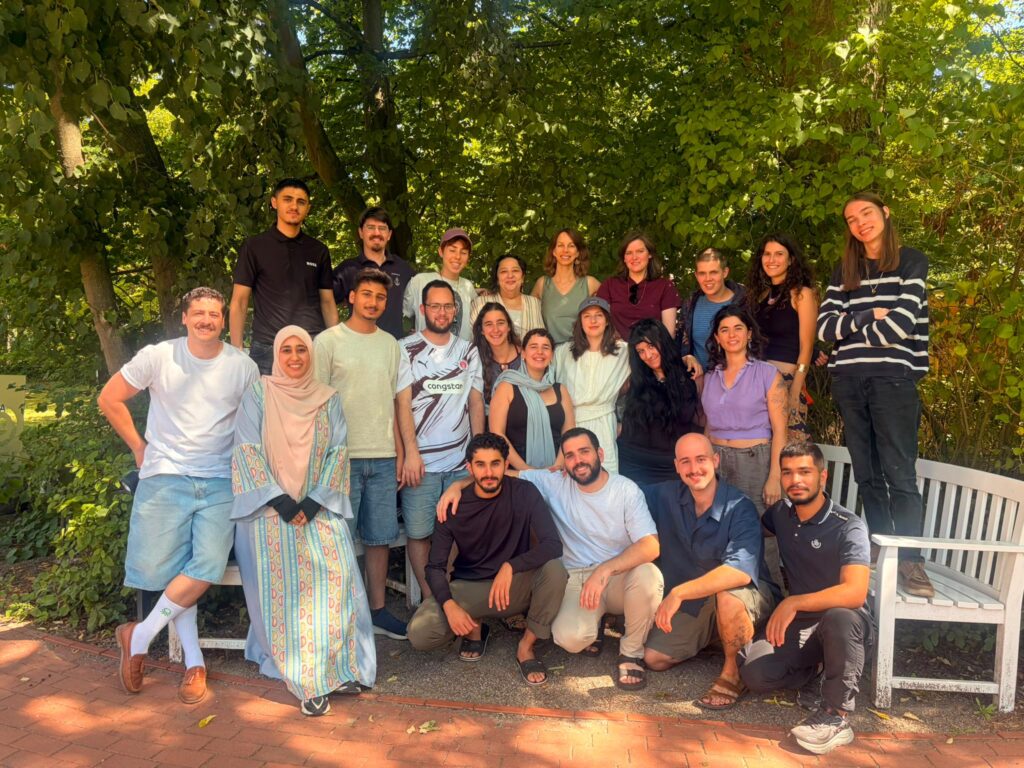
What connects us when our stories and perspectives are different? At the international seminar „Nation and Discrimination 2026“, young people from Germany and Israel came together to discuss identity, history, belonging, and discrimination.
Nation and Discrimination 2026 – Encounter, Perspectives and Joint Learning
Different stories, different perspectives – and a shared space for exchange. From August 1st to 9th, 2026, young people from Germany and Israel came together at the WannseeFORUM Foundation to explore identity, belonging, discrimination and different perspectives on history.
From one's own identity to national narratives
At the beginning of the week, the focus was on personal identity. Participants explored the question of which experiences, affiliations, and attributions shape them. It became clear that identity consists of many different facets – such as gender, cultural background, nationality, religion, profession, personal beliefs, and social roles.
Various exercises also explored which aspects of one's own identity strengthen and which can be experienced as restrictive or burdensome. Questions of power and societal attributions were addressed, as well as the perception of one's own position within a group.
From personal identity, the path led to family history and ultimately to the question of national belonging. Participants traced their families' paths over the past 100 years, revealing how migration, borders, and historical changes can shape individual biographies. Building on this, they explored how nations emerge, how belonging is constructed, and which stories take on particular significance for their own national identity.
History from different perspectives
A key focus of the seminar was the different national narratives. The German, Israeli, and Palestinian groups each examined historical events that shape their understanding of history and national identity. This revealed that the same history can be told and remembered from different perspectives.
The discussions focused particularly intensely on the Shoah, their significance for Jewish and Israeli memory, as well as the October 7, 2023 and its significance for Israeli society and memory. The participants also discussed the Nakba and the Palestinian National Movement as well as with the History of the division and the associated historical developments. The different narratives were not considered in isolation, but rather placed in relation to one another and discussed together.
Dialogue needs space and listening.
When dealing with a topic intertwined with personal experiences, family histories, and historical conflicts, dialogue requires special attention. Therefore, the seminar explored various forms of listening and perspective-taking.
The Witnessing Circles Witness circles formed a central component of this process. Within them, personal experiences and thoughts could be shared without immediate commentary or discussion. The other participants were initially invited to listen and hold the space for the recounted experience. This fostered conversational situations in which different perspectives could coexist.
The exploration of language and communication skills also played a role. Participants were encouraged to speak from their own perspective, to listen attentively, and to pause before reacting. Especially with controversial topics, such a moment can help to distinguish between one's own experience, the perceptions of others, and a hasty judgment.
Experience and make history visible
The content-based work was consistently complemented by creative and body-oriented methods. Exercises in mirroring, leading, and perception made it possible to experience how differently situations can be perceived and what responsibility is involved when one person takes the lead and another follows.
In the Human Sculptures (Human sculptures) The three national groups ultimately translated their perspectives into a shared physical image. The German, Israeli, and Palestinian participants each developed their own sculpture and presented it to the others. The initial focus was on careful observation before interpretations and feelings were formulated. Afterward, each group was able to explain what they wanted to express with their representation and how they had experienced the process.
The conscious alternation between observation, interpretation and self-explanation made it clear how quickly we assign meaning to images and situations – and how important it can be to first take a closer look and ask questions.
Historical sites also became part of the conflict. A visit to House of the Wannsee Conference and at the Bernauer Straße Memorial supplemented the work on history, memory and social developments.
Encounters create new perspectives
For one week, young people with diverse backgrounds and historical experiences came together. They asked questions, listened to each other, examined history from different perspectives, and sought ways to cope with even difficult topics together.
Especially when it comes to issues of identity, discrimination and the Israeli-Palestinian conflict, spaces are needed where different stories can become visible without reducing their complexity to a single narrative.
Nation and Discrimination This creates a space for encounters, civic education, and collaborative learning. The week demonstrates that dialogue doesn't mean everyone has to develop the same perspective. Rather, it begins where different perspectives are heard and discussed.
The seminar/project was a collaboration with:

This seminar was supported by:

Downwards to cooperation partners? ConAct – Coordination Center for German-Israeli Youth Exchangeh

