


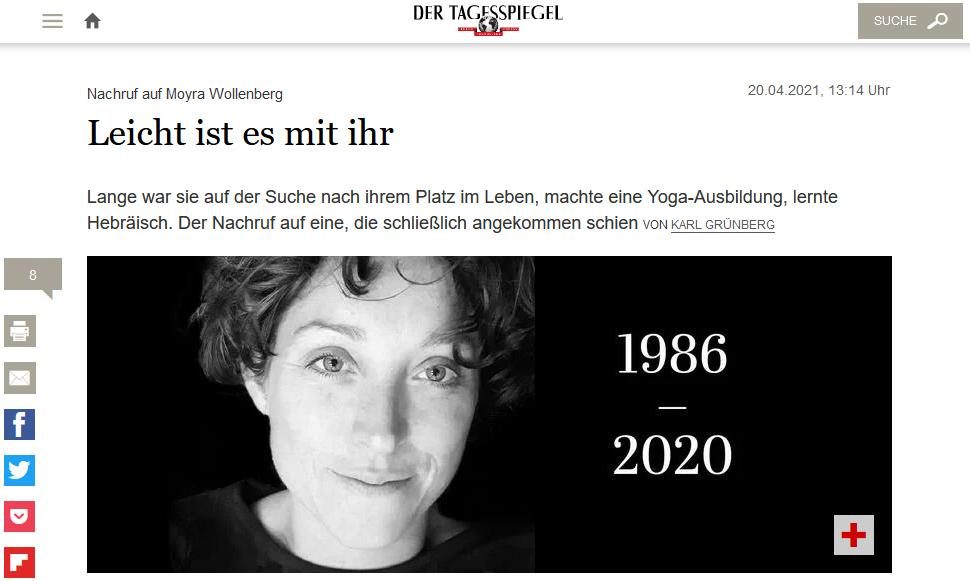
Moyra Wollenberg was a guest lecturer at wannseeFORUM for several years. The youth education center, and especially the concept for the welcome mentor training program she and Vinzenz Fenlger developed, were very close to her heart. We miss her.
The obituary written by Karl Grünberg and reproduced here appeared in the print version of the Tagesspiegel on April 18th and is now also available online:
https://www.tagesspiegel.de/berlin/nachruf-auf-moyra-wollenberg-leicht-ist-es-mit-ihr/27080424.html
Obituary for Moyra Wollenberg
It is easy for me
For a long time, she searched for her place in life, completed yoga teacher training, and learned Hebrew. An obituary for someone who finally seemed to have arrived, by Karl Grünberg
Suddenly, her friends burst out: "I was in love with Moyra." – "Me too." – "Oh, me too." – "And me, for months!" The friends look at each other, there's a brief silence, then they laugh. It's a Saturday in December. They're standing in front of the hospital's palliative care unit, drinking tea and coffee, smoking cigarettes, one is playing guitar, another is singing, some are weeping silently. One after the other, they go inside, down the stairs, through the chapel into a small room. There lies Moyra, laid out, very thin. Even so, they say, she looks like a queen, her lips painted red, her hair combed. Özgür made her look beautiful.
2011, Istanbul. Moyra is spending her semester abroad here. She wants to learn Turkish and conduct interviews with victims of domestic violence for her psychology thesis. But she also wants to go to parties, concerts, and experience the occasional adventure with a handsome man. She just doesn't want a relationship, and she's told Özgür that. He always looks at her with such love, invites her to breakfast and dinner, takes her for walks along the Bosphorus, texts her, and gives her a silver cigarette case. "I almost went crazy," Özgür says now. "I was always thinking about her. I wanted my infatuation to turn into love."
It's late, they're sitting in a restaurant, the Bosphorus outside. He's folded a letter so that she can only see short sentences at a time. "Do you want to know what the letter is about? Then keep folding." – "If you think I'm nice, then keep folding." – "If you think I'm good-looking, then keep folding." – "If you think something could happen between us, then keep folding."
“Oh Özgür,” she said, “you here, me in Germany, how is that supposed to work?” And then the last ferry to the European side of Istanbul departs, and Moyra spends the night with Özgür. Just cuddling. A promise is a promise.
The exhausting back and forth between father and mother
Kreuzberg, Skalitzer Straße: from her bedroom, Moyra can wave to the people on the subway passing by her window. This is where she and her younger brother live when they're with their father, a teacher. He travels the world with them, even building a snow cave in Norway to spend the night in together. When Moyra can't fall asleep, he massages her temples. Of course, her friends are welcome to stay over. The place is always packed. "Wherever Moyra was, her friends were always there too," her father says.
A few streets away live her and her brother with their mother, also a teacher, from Ireland. Moyra got her name and English as a second native language from her. She travels with her to Ireland to visit her many cousins, uncles, and aunts. There, she jumps laughingly into the cold sea. But the back and forth between her mother's world and her father's world is exhausting, especially when her father moves to the outskirts of town. She doesn't want to hear a single harsh word from her parents when they talk about each other. She always makes sure everything is fair. She mediates, she balances things out.
She desperately wants to go on an exchange year to the USA. Her mother finds it hard to let her go: a year without her is unimaginable. Moyra gets her way. Her first host family fits the stereotype; they ate canned food. When Moyra asks for something fresh, the father opens a can of potatoes. She flees to an aunt in Chicago. She returns more mature and organizes the preparation seminars for the next exchange students.
Moving out, high school diploma, psychology studies. Moyra is searching. In India, she trains to become a yoga teacher and falls in love with an Israeli man, learns Hebrew, and visits him in Tel Aviv. Next, she becomes interested in Shiatsu massage and trains in it for months. Then she falls in love with a Portuguese man and learns Portuguese. With friends, she goes to restaurants or salsa dancing, or she whiles away Saturdays having breakfast on the shared apartment couch.
Istanbul-Berlin, Berlin-Istanbul
Özgür doesn't want it to simply end just because Moyra has to return to Berlin. So much is different with her. The tenderness, even in public. They talk about everything that moves them, what scares them; there are no secrets. "Hugging Moyra is like therapy. When she listens, I feel understood." For a year, they commute, Istanbul to Berlin, Berlin to Istanbul. Then Özgür quits his job, applies for a language learner's visa, and comes to Berlin.
They take a rickshaw to the Neukölln registry office, their friends following behind on bicycles. The registrar says the wedding hall has never been so full. In the afternoon, they celebrate at Tempelhof Field; everyone brings something, and they all dance as the sun slowly sets.
Moyra becomes a family support worker in Neukölln, assisting parents and their children. She often deals with the most difficult cases, involving violence and neglect. Some parents struggle to even provide for their children. Sometimes things go well, and Moyra is able to make a real difference, which makes her incredibly happy. Other times, parents resist, bureaucracy gets in the way, the system fails, or children have to be removed from their families. These experiences deeply affect Moyra.
When all the helpers come together to discuss a case, Moyra insists that the cases be addressed as if the families were sitting at the table: not cynically, but respectfully. Anyone who witnesses Moyra at such meetings sees a strong and self-assured woman. Afterwards, she admits that she felt insecure.
On Sonnenallee, she manages to snag an allotment garden, which she goes to after work. There, she lies down on the grass, lets the sour cherries fall into her mouth, and watches the zucchini grow. Friends are always there. Moyra makes you "instantly happy," they say. She's easy to be around, and there's always something to laugh about.
In early 2017, Moyra turned 31. She was in excruciating back pain. Doctors had no explanation. She collapsed in the hospital lobby. Everything happened quickly: diagnosis, surgery, chemotherapy. Özgür stayed by her side, even when she was so ill she couldn't move. They talked for long periods when the fear overwhelmed them. They cried together when words failed them. Friends sent messages and pictures of candles in the WhatsApp group "Moyra's A-Team.".
Moyra makes it. A second chance. But what now? She talks to others who have also had stomach cancer. What wild herbs and vitamins can she eat to strengthen her body? What can she read, what can she occupy herself with to strengthen her mind? A search begins, including the question of whether and what can come after death. Finally, she feels so good that she begins training to become a psychotherapist.
Two years of traveling, celebrating, laughing, hoping, singing in a women's choir, then the cancer returns. Özgür takes a leave of absence from work and accompanies her every day and every night for months. Moyra is tormented by the question of what meaning her life could have had if she will die so young, without having accomplished much.
Moyra is getting thinner and thinner. She wants to go to the horses one last time, see her friends, and write a farewell letter to her two godchildren. When the time comes, they are all there: Özgür, her parents, and friends. Özgür keeps telling her that everyone loves her and that she can now let go of life.