


by Gabriele Naundorf & Uta Denzin-v. Broich-Oppert
The wannseeFORUM Foundation invites you to the Open Monument Day on September 12, 2021, between 3:00 p.m. and 5:30p.m.
The "Open Monument Day" in Berlin is a refreshingly citizen-friendly event. The State Office for the Preservation of Historical Monuments (LDA) sets the framework and informs the public. The participating monuments promote themselves through their own presentations. Interested citizens can choose from a wide variety of mostly free activities throughout Berlin.
The Open Monument event series started small on September 12, 1993.
In 1995, the wannseeFORUM was granted the status of "listed building" for the main building, the Kutscherhaus and the garden as the "Joerger Banker's Villa Ensemble".
Before the first Open Monument Day at wannseeFORUM, we asked ourselves:
Would anyone even be willing to visit a villa on the outskirts of town? There was no tourist attraction to be seen, but rather – according to the LDA's definition – a private house, renovated in accordance with historic preservation guidelines. Technical details of the renovation process – such as the careful cleaning of bricks and columns – dominated the first official Heritage Day. In addition, there were repeated guided tours of the house for the then more than 50, and later an average of 150, guests.
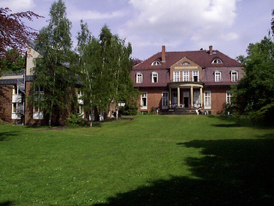
© Wannsee Forum Foundation 1999
It turned out that most visitors were not detail-obsessed experts, but rather people interested in history and society. The wannseeFORUM educational center, accustomed to catering to diverse guests, could therefore respond to this in a more relaxed manner in the future.
From 1999 onwards, there was a central motto for the Open Monument Days – as a unifying element: “Europe – a common heritage” was the first.
The Wannsee Forum always found points of reference in the changing annual themes, but above all it was able to connect with the broad interest of the visitors, who found not only the architecture and the history of the Joerger family, but also the history of the house as an educational institution and the content of the current youth education work exciting.
And that is also one of the purposes of the Open Monument Days: to give private owners, associations and foundations that are committed to preserving listed buildings and sites an opportunity to present their work to the public.
Dedicated work on and in listed buildings like the wannseeFORUM means not only halting structural decay and carefully restoring according to historical models, but above all, it means treating the monument with respect. In this respect, the Villa Joerger complex is also a joint project of all foundation members, freelance staff, and the young people who are the core target group of the wannseeFORUM.
And this place is treated with great care! Those responsible for the wannseeFORUM are committed to preserving this space for young people.
And the young people are very aware that, in addition to the content-related work, the beauty, the atmosphere, the well-maintained nature of this place is also an expression of appreciation for them, and they "honor" it.
Visitors come to the Open Monument Day for a variety of reasons: whether it's due to a specific interest in information, whether – having already visited the Alsen villa colony – they also want to "take in" the nearby WannseeFORUM, or whether the additional offer of coffee and (homemade) cake is a big draw.
Whatever the reason for a visit, the vast majority are delighted, albeit for different reasons: Some grab a coffee, stroll into the garden, barely listening to the explanations about the listed garden – the role of the birches, the typical duo of pedunculate oak and beech – but simply surrendering to the magic of the place. Architecture enthusiasts and students follow in the footsteps of the architects Breslauer and Salinger and learn about the history of the house; retired teachers who brought their classes here long ago want to refresh their memories and learn about current teaching practices; others are interested in re-education in post-war Berlin or want to have the "workshop principle" of the house's political and cultural education work explained to them.
The "house" is always prepared: photos and collages in the foyer provide information about the past, and videos offer insights into current work. Staff members of the wannseeFORUM, board members, and trustees conduct tours, answer questions, and ensure a steady supply of coffee and cake.
This continued for many years until 2020, the year of the pandemic, which necessitated a change in the format of the Open Monument Day. "AHA+L" took over the reins.
© Wannsee Forum Foundation 2020
Some events could still take place in the "cross-ventilated" foyer, but most were moved outdoors. And the program returned to its origins: For example, the many individual and small-group discussions of previous years evolved in 2020 into a cohesive historical and cultural event, culminating in a short concert by the saxophone quartet
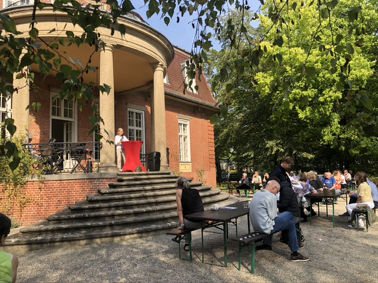
© Wannsee Forum Foundation, 2020
“Jet Fisher’s Handicraft Circle” and a lecture on the connection between the history of the Joerger family and that of the house:
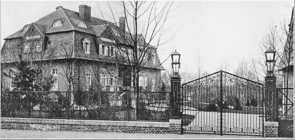
© Villa Joerger Erben approx. 1908
At the beginning of the 20th century, Carl and Elisabeth Joerger were looking for a suitable location for their summer residence and found it in Stolpe, two miles outside Berlin on the Pohlesee. Their main residence was on Lennéstrasse in Mitte, near the workplace of Carl Joerger, who was a co-owner of the Delbrück Bank at Potsdamer Platz.
There was already a train connection from Potsdamer Platz to Potsdam with a stop in Wannsee.
They hired Alfred Breslauer and Paul Salinger as architects; they had a joint office in Potsdam and were considered modern architects, especially for country houses.
The fact that the two were of Jewish origin was apparently no obstacle for the upper-middle-class Joergers, of Old Catholic and Protestant religious affiliation respectively.
Villa Joerger was built in 1907/08 as an outstanding example of high-quality Landhausarchitecture with elements of Brandenburg manor houses. The building is perfectly symmetrical, as is particularly evident from the view of the brick facade with its portico from the lake side.
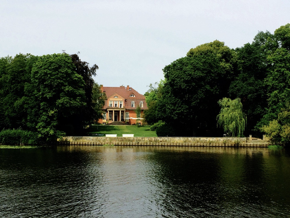
(c) WannseeFORUM Foundation, 2016
The decorative panels beneath the windows, featuring floral motifs and surprisingly rendered in shades of brown and ochre, are a defining stylistic element. The window frames and shutters are painted not the usual white, but a light gray/beige. This soft color scheme underscores the elegance of the architectural design. Incidentally, the original color analysis was made possible with the support of the State Office for Heritage Management (LDA).
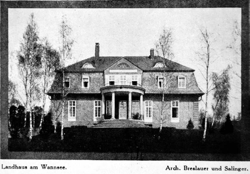
© Source: The Elegant World, p. 21
For the interior design of the house, the architects used modern construction techniques such as concrete. The ambiance reflected the Joergers' social standing. The ground floor featured grand, high-ceilinged rooms. From the spacious reception hall, an imposing double door led into the Kaminsaal, which in turn opened onto the portico with its sweeping view of the lake. Further reception rooms adjoined this space.
There was a dumbwaiter from the basement, with stops in the kitchen and on the first floor.
On the first floor were the master bedroom with a balcony overlooking the lake, the children's bedrooms, the nanny's room, and two large bathrooms. There were additional rooms for staff in the attic.
The Joergers now had four children, which made a move to the countryside seem like a good idea. In 1920, the family moved permanently to Wannsee. Their Kutscherhaus ensured they had plenty of transportation
The brick building contained a carriage house, stalls for two horses, an apartment for the coachman, and a hayloft in the attic. Carl Joerger is said to have ridden to Wannsee train station. The Kutscherhaus remained unusual among the other houses built on the Kleiner Wannsee (Little Wannsee); these usually included elaborate boathouses.
The idyllic image of life by the lake ended abruptly with the death of Carl Joerger in May 1945. Wannsee was the last district in the ring around Berlin to be captured by the Soviet Army after fierce fighting. During the occupation, a soldier shot the homeowner. Elisabeth Joerger died shortly afterward of exhaustion at the home of friends.
When Wannsee became part of the American sector, the Americans requisitioned the villa as accommodation for high-ranking officers. They returned it in 1950 to the Joergers' heirs, who then sold the two houses and the garden to the Wannseeheim Youth Work Association for 120,000 DM. Today, there are friendly ties between the Joergers' descendants and the wannseeFORUM Foundation.
The history of the building also includes the fate of its architects. Alfred Breslauer was expelled from the Academy of Arts in 1934 as a "half-Jew" and emigrated to Switzerland in 1939. Paul Salinger was deported to Theresienstadt in 1942, where he died that same year.
The Joergers were not Nazis during the Third Reich, however, Carl Joerger was connected to the ruling clique through banking and economic bodies. On the other hand, for the Joergers' cosmopolitan and tolerant lifestyle, it was not a problem to commission Jewish architects for the construction of their house, even though a new wave of open anti-Semitism arose again from the 1890s onwards.
It is these ambivalences that are also discussed as a topic in our “open monument”, the youth education center
“Think_monument sustainably” was the motto of the 2020 Open Monument Day. It captures the essence of the wannseeFORUM Foundation's mission – because what could be more sustainable than continuous youth education! The fact that this work takes place in such a location allows young people from diverse backgrounds to experience not only a wealth of political and cultural content, but also “beauty” – an architectural masterpiece in a meticulously designed park.