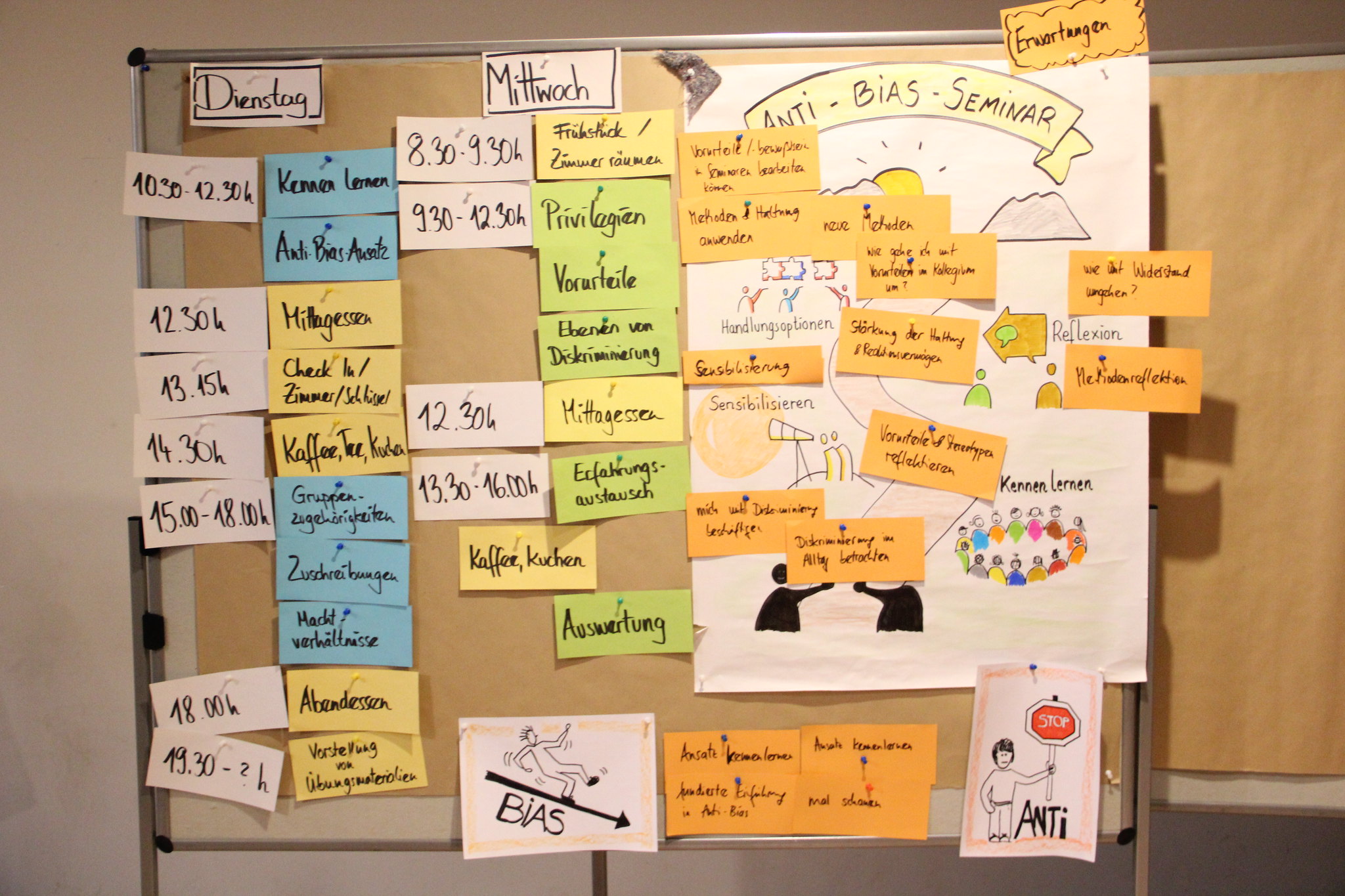
No one is without prejudice. However, becoming aware of one's own prejudices, critically reflecting on them, and examining one's own attitudes and actions accordingly is a prerequisite and basis for the work of political educators – including at the wannseeFORUM. A training course on "Anti-discrimination in youth education" on December 20th and 21st, 2016, therefore offered the opportunity to learn about the anti-bias approach and its methods as a path to prejudice-aware education.
You are currently viewing placeholder content from the standard version. To access the actual content, click the button below. Please note that this will involve sharing data with third parties.
Anti-bias method: "Identity onion"
The anti-bias approach, first conceived in the USA in the early 1980s as a counter-model to "traditional" multicultural pedagogy and continuously developed since then, is steadily gaining importance in anti-discrimination education. It focuses on clarifying one's own individual prejudices and attitudes as well as recognizing societal power structures and relations of domination, for example, through structural discrimination and unequal treatment in institutions and organizations. Its methods sensitize learners to the mechanisms and functions of prejudices, stereotypes, and clichés on both subjective and societal levels. The central focus is on a critically reflective examination of one's own perspectives, actions, and positions in relation to prevailing societal assumptions. Through this engagement, participants in anti-bias seminars and/or methods should be able to test and develop alternative approaches to discriminatory forms of communication and interaction. Anti-bias work aims overall at societal changes towards a prejudice-aware and discrimination-free society.
You are currently viewing placeholder content from the standard version. To access the actual content, click the button below. Please note that this will involve sharing data with third parties.
Annette Zimmermann, a freelance educational consultant specializing in youth and adult education, introduced this approach to the participants of the training course and also facilitated the testing of methods. These included, for example, the "Identity Onion" exercise, through which the participating multipliers got to know each other "layer by layer." Together, the seminar then explored prejudices, their functions and mechanisms, as well as power imbalances and discrimination at their various levels. Exercises on group affiliations, attributions, generalizations, and stereotypes were followed by discussions and exchanges on their application in the pedagogical practice of political youth education. How do we deal with prejudices held by young and adult seminar participants—even outside of dedicated anti-discrimination workshops? How do we address structural and societal discrimination in our seminars and convey options for action and their limitations? The anti-bias approach emerged in the training course as one way to approach these questions. The question of how to make prejudices visible and how to live diversity in an appreciative way will remain an important part of everyday educational practice and a continuous topic for further training on anti-racism in youth education.
You are currently viewing placeholder content from the standard version. To access the actual content, click the button below. Please note that this will involve sharing data with third parties.
Cooperation instead of exclusion – trying out the Froebel crane for use in seminars
More impressions from the training course
The wannseeFORUM Foundation is a recognized sponsor of the Federal Agency for Civic Education.