


From June 12th to 16th, 2017, two 11th-grade classes from the Louise-Schroeder-School the wannseeFORUM to explore the seminar topic "Arrival and Reception" and to develop their own artistic and media projects. The seminar was held in cooperation with the Steglitz-Zehlendorf Adult Education Center and grenzgänger I Research and Training , and was funded by the Berlin Senate Department for Education, Youth and Family.
In keeping with the spirit of a smooth start, the seminar began with a welcome plenary session, an introduction to the educational institution, an opportunity for initial introductions, and an overview of the program. Migration researcher and border crosser Manuel Assner, in his introductory remarks, posed questions about the structure of an immigration society:
• Who is this society?
• Who is part of it, who is allowed to be part of it, and who decides?
• Who is allowed to come? Who is allowed to stay? Who should/must leave?
The answers to these questions already reveal much about the character of the respective society. Manuel Assner emphasized that no country in the world has ever managed without migration and that the freedom to choose one's place of residence is a fundamental human right.
A sociometric analysis visualized the diverse migration experiences within the seminar group, and the subsequent discussion revealed that Germany has always been shaped by immigration and emigration.
In the "1-Step-Forward" exercise, participants took on different roles, all of whom had immigrated to a fictional Sagaland and now faced vastly different opportunities and chances for advancement within it, depending on their origin, qualifications, and (attributed) characteristics. This vividly illustrated the exclusions and privileges that can make arriving and integrating into a new society more or less difficult.
To explore the seminar topic, participants participated in two city tours organized by the "border crossers" (a local initiative). While one group explored the Moabit district, focusing on the lives of undocumented migrants, the other group ventured to Neukölln to investigate the diversity within the urban space and the variety of its neighborhoods. By addressing the processes of change in the districts, migration became a tangible reality, and not just since the summer of 2015. Back at the wannseeFORUM, an information table with brochures and background materials, as well as computers for research, were available for further exploration of the topics raised.
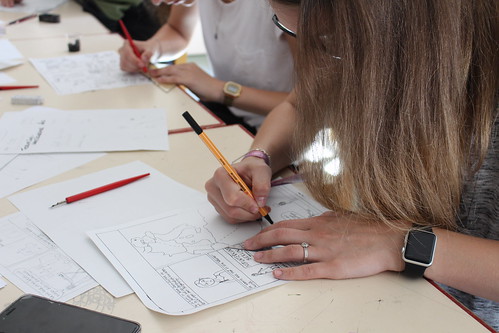
Well-prepared, the participants began working in small groups. They could choose between the following workshops: rap, app design, audio, comics, and theater. Each workshop focused on different aspects, which were then explored through artistic and media-based approaches
The app group explored concepts such as foreigners, locals, and self-identities versus ascribed identities. Engaging with power and presence in urban space, they developed the walking tour "(Wann?)See der Entscheidungen" ), featuring various stations under headings such as "Expulsion and Arrival," "Good Neighborhood?", "Living Side by Side Instead of Together," "It Tastes Good Elsewhere Too…", "Integration Through Sport," etc., where participants' perspectives on migration are presented through short films, interviews, and texts. The "Digi Walk" for the walking tour in Wannsee can be downloaded here.
The rap group discussed at length what it feels like to arrive somewhere new, what one can do personally, and also how the group can help someone settle in. They summarized their thoughts in the song "Es wird Zeit" (It's About Time). It's about respect and better coexistence, but listen and see for yourselves:
You are currently viewing placeholder content from Vimeo. To access the actual content, click the button below. Please note that this will involve sharing data with third parties.
The audio group explored what motivates people to come to Germany, what hurdles they face upon arrival, and what contribution we ourselves can make to creating a livable environment. Through role-playing, they examined various perspectives on migration and discussed, among other things, the advantages and disadvantages of remittances. Their audio contributions, "Come to Work," presented as a street survey, a background report , and an expert debate , addressed prejudices against people who come to Germany for economic reasons.
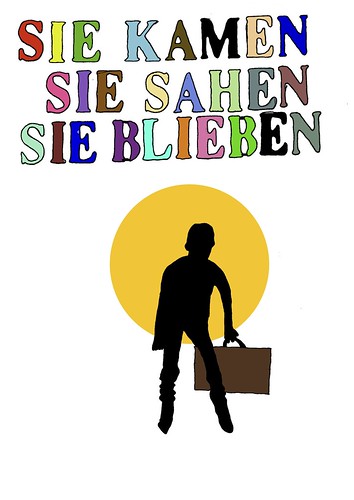
The comic group examined migration to West Germany (and East Germany) and the positions and reactions within the immigrant society since 1960. Based on the experiences of various individuals who migrated to Berlin between 1960 and 2017, characters were created. The location and encounters served as the starting point for developing a storyboard: How am I received? How do I react/can I react? Why did I come here? What do I find? etc. This resulted in the comic book "They Came, They Saw, They Stayed."
The theatre group then explored different perspectives on migration in Germany. They considered the situations in which people are discriminated against and how courageous intervention against it is possible. Through role-playing, they were able to shift their perspective and develop empathy for the situation of those affected. In the theatre scenes they ultimately performed, titled "Ticket, please!", they demonstrated one possible way of dealing with discrimination: showing solidarity with the person affected.
On the final day of the seminar, the results from the workshops were presented to a public audience in the Theatersaal of the wannseeFORUM. The students' presentations, which clearly demonstrated the week's intensive work, were met with enthusiastic applause. We hope all the students felt welcome and wish everyone involved every success in shaping an inclusive society.