
Training course “Welcome Mentors”
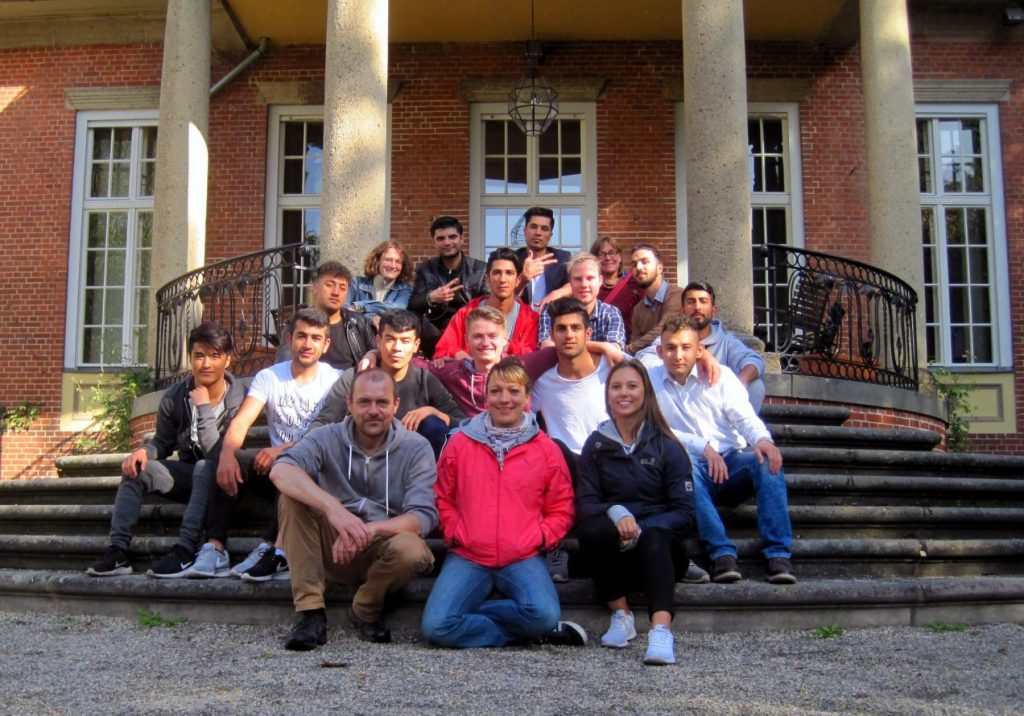
From "them" to "us" – that's one way to summarize the three days of seminars at the wannseeFORUM. Students from the Louise Schroeder School attended, some from regular classes and most from welcome classes. They brought with them the idea of launching a project at their school to bring the young refugees, who are diligently learning German in separate classes, and the other students closer together. Everyone unanimously reported that they were already eyeing each other up, but they weren't taking the crucial step of approaching one another. Too much shyness due to limited German skills on the one hand, and fear of contact due to a lack of information about "the newcomers" on the other, were the reasons, it was noted. And this is precisely where the seminar concept comes in: getting to know each other, breaking down barriers and prejudices, and working together to create something: becoming ambassadors for a harmonious coexistence. Inclusion, not one-sided integration.
And so, the first day of the seminar combined team building and getting to know each other with an in-depth exploration of the topic of "diversity." Through various collaborative exercises, the process was symbolically traced from the initial shared beginning, through writing a project idea, to its implementation. The seminar concluded with an inventory: What do we already have at the school, what is still missing, and why is it still missing?
The second day of the seminar focused on a more in-depth exploration of the topics: What does inclusion actually mean? What are the criticisms of one-sided integration? How do democratic negotiation processes work? How do prejudices arise, and how can they be dismantled? These questions were discussed at times in small groups to provide a safer environment, especially for the young refugees, helping them overcome their hesitation to express themselves despite their limited German skills. For this reason, much of the material was visualized, broken down into simpler, and made more understandable. Empathy and the ability to shift perspectives were essential. But this had already been practiced on the first day: participating in an exercise blindfolded, understanding the language but being unable to see.
The afternoon continued with the larger group. Two Betzavta exercises (a democratic education training program from Israel) made mechanisms of exclusion visible and allowed for collective reflection. This playful self-discovery and learning provided further topics for discussion around the campfire that evening.
The final day was dedicated to the concrete implementation of what had been experienced and learned: an action plan was needed. With the support of the trainers, work began on a specific project: What do we want to implement at the school, what are the first steps, who does what, why, and with whom? Who are our supporters? What obstacles might we encounter?
When the rolling suitcases struggled through the gravel of the wannseeFORUM courtyard on Wednesday afternoon, one thing was clear: these were young people leaving with a strong sense of community and ambitious plans. You could see it in their eyes.
The measure took place as part of the project “Empowered by Democracy” of the Federal Committee for Political Education (bap eV) .