


The shadows are growing ever longer. With every move online and every step we take with our smart devices, we leave digital traces. This digital shadow is part of us, part of who we are. But how does it arise, who influences it, and how do our own actions determine its form? These were the questions that students in grades eight through ten at Friedensburg High School explored at the start of the seminar "My Digital Self.".
The question "Who am I?" takes on entirely new facets in the digital age. How does digital society change our view of ourselves, of others, and of how we communicate, learn, and act? To explore "My Digital Self" from different perspectives, the seminar began in the "Self-Lab" with three experiments designed to stimulate participants' own questions, research, and discussions.
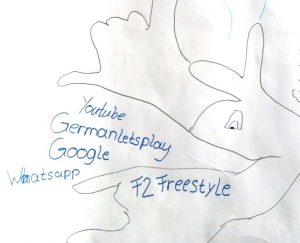
In addition to recording the "data self" through one's own data shadow, the "Machine Self" station explored how machines are changing human activities. In which everyday situations will smart devices naturally take over our actions in the future? Short role-playing scenarios were devised and filmed to explore this. The "Virtual Self" station focused on designing a character from digital games in the form of a playing card with an image and attributes. This station encouraged participants to consider the relationship between avatars, virtual characters, and players.
What influence do digital games have on the development of our own perspectives, on our virtual selves, and on our real-world actions? Why do we play, and how much gaming experience do the participants already have? One of the film workshop groups took up these questions from the introductory phase and began researching the gaming scene, game formats, motivations, communities, and the content of selected games. Their discussions resulted in two video projects: "Pacman Game Over," a real-world adaptation of the classic game, and "#cut4akku," featuring interviews with gamers about their perspectives.
A second film group explored YouTube as a site for young people's understanding of the world. How does the video platform, as the leading entertainment medium for young people, shape their perception of self-presentation? What significance do the information and opinions conveyed by YouTubers have, and what media techniques are behind it? In their own sports channel, the workshop group experimented with YouTube's mechanisms, revisiting the question of "human robots" from the beginning of the seminar. None of the participants yet believe that athletic competition with robots has a bright future
The third workshop group began its work phase by exploring the enduring
global selfie trend. How do we present ourselves today? How does self-representation via digital media change our perception of community and the individual's role within it? To implement the ideas generated in the discussions, the workshop participants chose various animation techniques. They experimented with puppetry, stop-motion animation, and hand-drawn animation, learning in the process how crucial patience and teamwork are for a technique where each individual image must be created from scratch. The result was a series of short animations that examine whether posting on social media during an event becomes more important than experiencing the moment in person, how antivirus programs can influence one's digital footprint, and what a selfie might look like in a future of unlimited possibilities.
It became clear in all discussions and media projects how strongly questions of self-image and how others perceive us in the everyday online sphere shape our digital actions. Dealing with one's own image and that of others, understanding the legal framework as an expression of current social conventions, and applying this knowledge in one's own media productions became an important aspect of exploring the "digital self."
With the increasing pervasiveness of digitalization in everyday life, questions about digital identity, its development, media influences, and the framework of media society will play an increasingly important role in future seminars, in order to empower young people as users and producers, especially of digital content, to act consciously and critically.