


The workshop “NEVER AGAIN. Nazi Crimes, Resistance and Remembrance Culture in Germany”, April 6–18, 2020, built upon the one-day workshop “My/History” held on December 14, 2019, at the Sachsenhausen Museum and Memorial. Impressive films were created during the workshop based on the fascinating research conducted there.
Please note that by clicking on the following images and links, data will be transmitted to Padlet and/or Vimeo; see privacy policy..
Due to Covid19 and the resulting closure of the memorial site, we had to change the original seminar concept: Instead of realizing artistic works together on site at the former prisoner camp in Oranienburg as planned, we developed digital and socially distanced projects on the topic on site in Berlin.
The focus was on aspects of resistance and solidarity during the Nazi era in the immediate neighborhood of the participants: specifically, around their own block. They researched background information about their respective districts online, including on the websites of the Memorial to the German Resistance and the Documentation Center for Nazi Forced Labor.
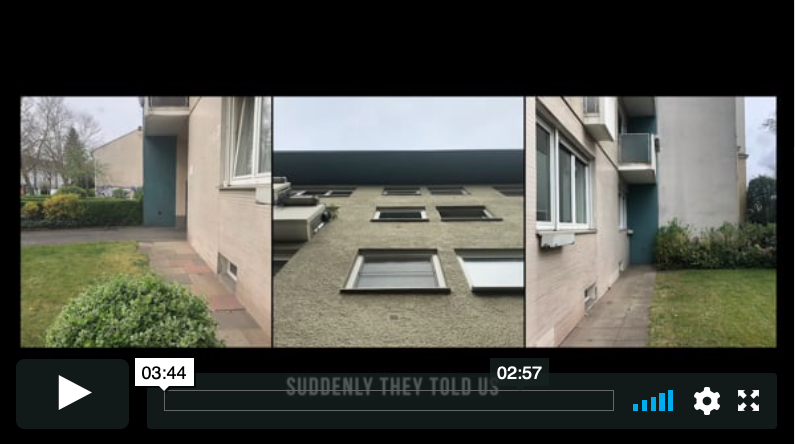
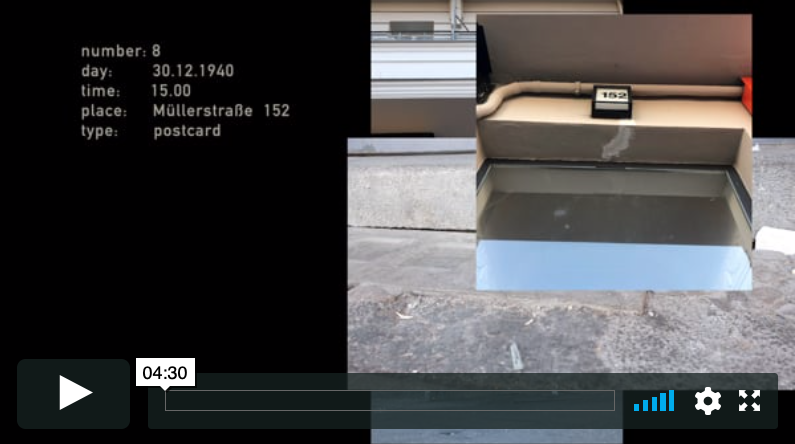
At historical sites of Nazi persecution and exploitation, and at sites of civil resistance, the participants then collected photographic evidence. On foot, during walks, they searched for clues and forms of contemporary commemorative culture: stumbling stones or memorial plaques relating to Nazi crimes, forced labor, the external work detachments and satellite camps, the companies and firms, to individuals, to forms of solidarity, and to acts of resistance.
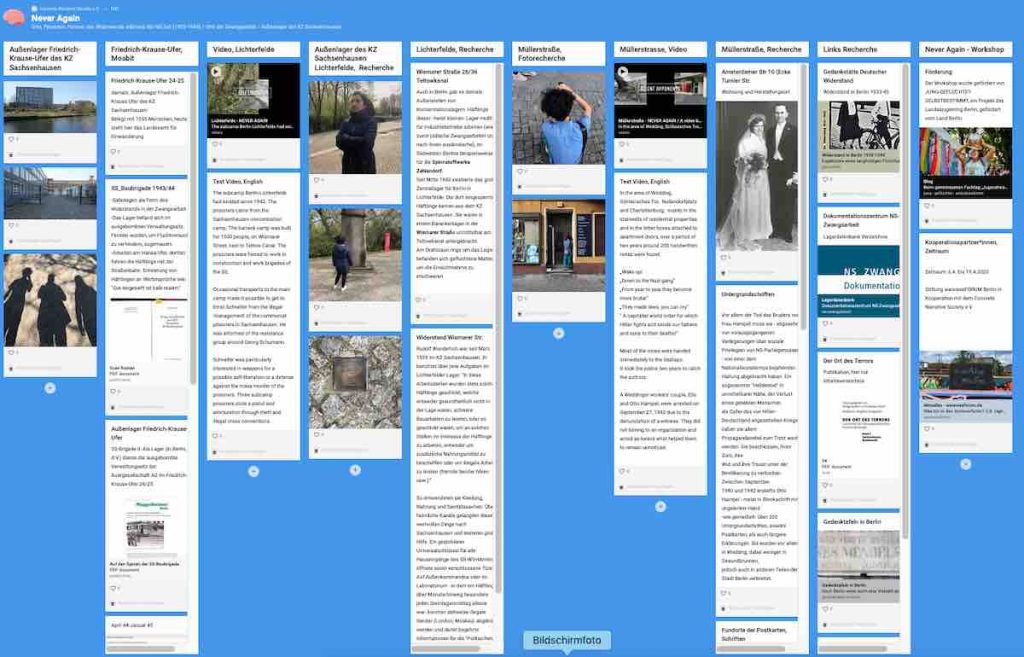
The online Padlet Never Again documents the explorations of the immediate neighborhood (Moabit, Lichterfelde, Wedding) by the participants and illustrates how the Sachsenhausen concentration camp was networked with the city of Berlin, for what purpose and where forced labor took place and who profited from it.
The questions explored were: What forms of solidarity and resistance existed among the prisoners, as well as from the general population? How does remembrance and commemoration change when there are no longer any eyewitnesses to recount the events? What do these sites of terror mean for us today? Can these places be reimagined and opened up as spaces for dialogue and encounter in times of right-wing populism, right-wing extremism, and closed borders?
All participants rediscovered Nazi history and its connection to forced labor. The network of the Sachsenhausen concentration camp and the extent of its economic exploitation were brought into sharp focus. Research into forms of resistance and the search for "keywords" for the video works also highlighted the topic's relevance and connection to personal experiences such as war, flight, emigration, and discrimination.
A collaboration between the wannseeFORUM Foundation and the Concrete Narrative Society eV.
Seminar leader:
Katja Pratschke is a media artist, author, and lecturer. Her artistic practice encompasses work with film, video, photography, installation, and interactive sculptures.
Dr. Roman Fröhlich is the educational director of the wannseeFORUM Foundation and holds a doctorate in science from a subcamp of the Sachsenhausen concentration camp. He regularly works with teenagers and young adults on the topic of Nazi crimes.
The workshop was supported by JUNG. GEFLÜCHTET. SELBSTBESTIMMT (Young. Refugees. Self-Determined), a project of the Berlin State Youth Council, funded by the State of Berlin.