


What does our digital society look like today and in the future?
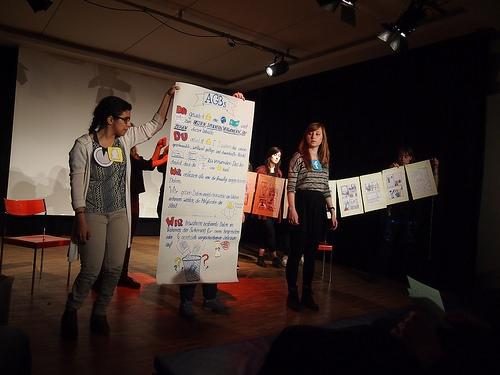
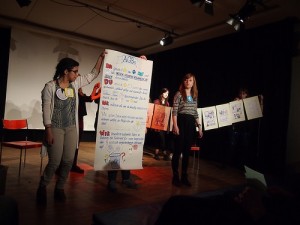
"2060: IT giants, pharmaceutical companies, and insurers have joined forces and made the impossible possible: a healthy world!" This sensational news comes from one of the texts written by the workshop group "Staged Reading" in the seminar "Society X.0 – Everything Networked?". "Politicians and citizens have... discovered that self-tracking has improved people's performance in all areas," it continues. However, a few scenes later in the performance "Quantified Self," people who exercise little and drink a lot of coffee are placed in the "Useless Customer Unlimited" plan by their health insurance company. Do fitness trackers change individuals and society? Can digitalization and data processing solve global problems such as illness, mobility, and democratization?
You are currently viewing placeholder content from the standard version. To access the actual content, click the button below. Please note that this will involve sharing data with third parties.
Trainees from the OSZ Louise Schroeder researched, discussed and produced their own contributions on this topic from April 4th to 9th in five different workshop groups with different focus areas.
You are currently viewing placeholder content from the standard version. To access the actual content, click the button below. Please note that this will involve sharing data with third parties.
In their radio play “Kimchi yeah – 2020. A Utopia”, the audio workshop group combines unidentified flying objects, election campaign strategies using smart data glasses, a mass crash of self-driving cars and other visions of the future with the question of digitalization and freedom.
You are currently viewing placeholder content from the standard version. To access the actual content, click the button below. Please note that this will involve sharing data with third parties.
The multimedia workshop is posting job ads and a promotional video for "web cops" on its blog , among other things. In a commercial titled "we hide you," an agency promises to create a flawless online image. The clip "Caritim-Lens – the future in the moment" advertises a contact lens that allows users to see in the dark and underwater, while simultaneously zooming and taking direct photos and videos. A rosy outlook or a bleak vision?
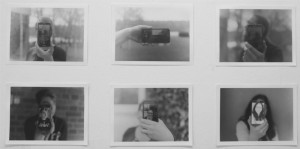
Using analog technologies, the black and white photography workshop group explores the already ubiquitous flood of digital images and the relationship between individual and technology-dominated decision-making in image production and content. The exhibited photo series reflect, among other things, changes in urban landscapes and everyday life brought about by the constant presence of technology. The relationship between individual perspectives, device-influenced perception, and the resulting forms of representation is also addressed – in unique original prints from the black and white darkroom.
You are currently viewing placeholder content from the standard version. To access the actual content, click the button below. Please note that this will involve sharing data with third parties.
At the comic group's final presentation, each individual page of their collaboratively developed comic, "Do You Really Want This?" , unfortunately only remains visible for a few seconds before self-destructing—just like in the Snapchat app, a rapidly growing instant messaging service for sending images. However, the self-destruction is only simulated. The originals remain intact—just as they do in Snapchat, as the group discovered with surprise when they looked at the terms and conditions. This workshop group connected the role of photo communities in their own social lives with the question of the significance of images and comics in journalism. They also received input in a fascinating Skype conversation with Dirk Walbrühl about the approach of constructive journalism, as practiced by "Perspektiv Daily." "What could the future of journalism look like?" was one of the comic group's questions, a theme that will also be explored in upcoming seminars on "Society X.0 – Everything Networked," for example, at the next seminar date: June 20-25, 2016.
More impressions from the seminar
The seminar was funded by the Senate Department for Education, Youth and Science

and took place as part of the collaboration in the program “Political Youth Education in the AdB” in the project group “Globalization and Media Communication”.