


A seminar on nutrition in the globalized world
Which is the world's largest food company: PepsiCo, Nestlé, Tyson, or Kraft? Approximately how many different apple varieties are there worldwide: 30,000, 54, 150,000, or 2,000? From which country did croissants originally come: Turkey, France, England, or Austria?
– These are some of the questions and answers in the "Nutrition Quiz," which the 26 students of the Carl von Ossietzky School to playfully explore the topic in the seminar "The World Eats... – Nutrition and Globalization" (November 30–December 5, 2015).
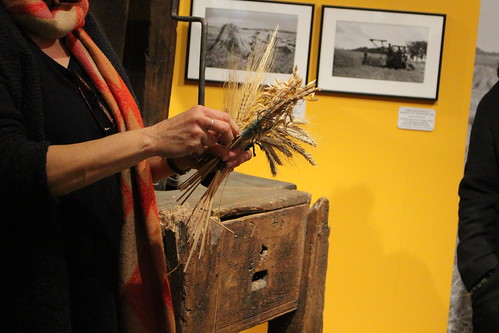
The human right to food and the “silent hunger”
The introduction to this complex topic continued with a presentation by Mareike Bethge, speaker on the focus topic "Full is not enough! The future needs healthy nutrition" at Bread for the World. The central questions of her presentation were: "What does healthy nutrition mean, and what impact do globalization processes have on eating habits worldwide?" The presentation also addressed the right to adequate food as a human right, clarified terms such as "silent hunger," "malnutrition/undernutrition," and "land grabbing," and provided information on the situation in developing and industrialized countries. Using statistics, it was illustrated that certain groups are more severely affected by hunger—and thus also by malnutrition—due to their socioeconomic situation (e.g., women, small-scale farmers, etc.) or their physiological conditions (e.g., infants, children, pregnant and breastfeeding women, etc.). The connections between the power of globally operating food corporations and the situation of small-scale farmers in developing countries were also highlighted, and the impact of our dietary habits on life in a globalized world was discussed.
"We were ripped off!"
In the subsequent role-playing game, "Who Profits from Bananas?", participants had the opportunity to put themselves in the shoes of the various actors involved in banana production and trade. During the debriefing session, the discussion focused primarily on the severely disadvantaged situation of banana pickers, who are economically dependent on the decisions of other decision-makers (plantation owners, import/export companies, and supermarket chains): "We've been ripped off!" was the conclusion of one "plantation worker." The extreme power imbalance between the roles not only caused outrage but also sparked a discussion about their own agency as consumers.
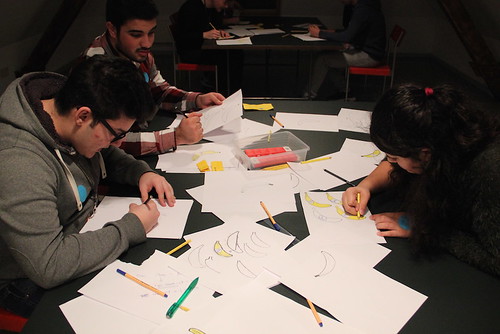
After the joint introduction, from the second day of the seminar the participants worked in three workshop groups (rap, theatre and audio/weblog) and presented their findings and positions on different facets of the topic in the respective medium.
In the "Rap" workshop , participants explored the topics of exploitation in the global food market and food waste. They wrote their own lyrics, rehearsed, and recorded their best performances. The group also produced their own music video, which was presented to guests on the penultimate day of the seminar, in addition to their live performance.
You are currently viewing placeholder content from Vimeo. To access the actual content, click the button below. Please note that this will involve sharing data with third parties.
The participants in the theater workshop developed their own play, set in 2030, the year in which the deadline for implementing the United Nations' seventeen Sustainable Development Goals—including the eradication of world hunger—expires. Globally, however, there seem to have been no major changes—despite the narrator's portrayal of a "better" world where, for example, fair conditions prevail in the job market. In the fictional state of Aliambra, banana pickers are exploited by the general, who in turn tries to meet the king's quality standards for bananas. In another part of the world, the excessive consumption of junk food and eating disorders resulting from media-driven ideals of thinness are part of the daily lives of the female protagonists. "Justice" is what the young actors demand at the end of the play.
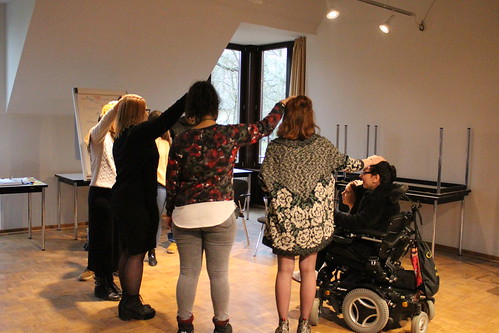
The artistic work was complemented by an excursion to the Dahlem estate, where the workshop groups “Rap” and “Theater” visited the “Culinarium” exhibition and concluded with a conversation with Katharina Olschenka, co-founder of the delivery service “Lokalbestellt”.
In the "Audio/Weblog" workshop, participants primarily explored the conditions under which food is produced and its origins. They presented their resulting audio pieces in the form of a radio program "36.1 Nutrition on Berlin FM ." The centerpiece of the program was a report from Markthalle NEUN in Kreuzberg, featuring various stallholders, some of whom are also local producers, who introduced their regional and organic products. The program was further enhanced by a conversation with Florian Kliem, co-founder of Kantine NEUN. In the interview, the food expert advocated for making the origins of food products and their local and global production conditions visible. He argued that this could foster an appreciation for food among consumers and simultaneously raise their awareness of the impact of their consumption habits.
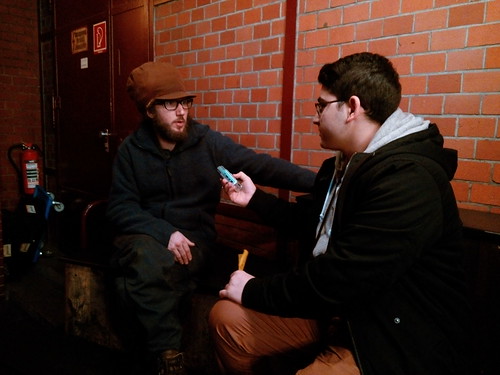
In addition to the radio broadcast, the participants of this workshop created their own internet presence entitled "NutritionInBerlin", on which the results of all working groups were included.
Photo impressions from the six joint seminar days on Flickr
The seminar was funded by the Federal Agency for Civic Education and the Senate Department for Education, Youth and Science.

