


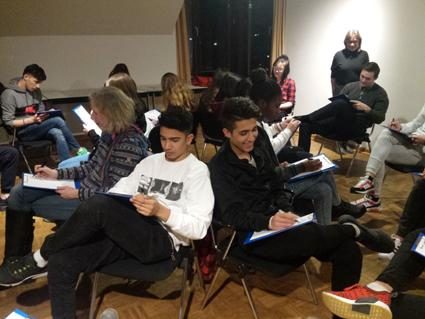

“Where do we stand – what’s next?” could be the title of the two seminar days at the wannseeFORUM Foundation at the end of February.
The training was designed to offer schools that had already completed an initial seminar focused heavily on raising awareness. As a "refresher," these schools returned to the wannseeFORUM for two days to receive support during the implementation phase of their welcome projects, to refresh their knowledge, and to further develop and refine their role as mentors.
This time, welcome mentors from the Louise-Schroeder-School and the Barnim-Gymnasium had traveled to visit. They brought suitcases full of experience from implementing their projects, but also questions and curiosity about exchanging ideas with the other school. How do they do it? What worked for them, what didn't? Why not? What can we do better, how can we learn from them, and what can they learn from us?
And with this in mind, after a brief introduction, the event began: Participants presented their projects to each other, named conditions for success, and were not afraid to be self-critical about what had not worked so well since leaving the predecessor seminar at wannseeFORUM and entering everyday school life.
But getting to know each other and spending leisure time together was also important, as several students were new to the projects and attending the wannseeFORUM for the first time. To this end, the trainers had prepared an introductory evening with fun games, preceded by an intensive work phase. Using a Betzavta exercise (a democratic education training program from Israel), democratic negotiation processes and conflicts were made visible and reflected upon together. Through this playful self-discovery and learning, many realized that such processes are not always easy, as they sometimes caught themselves engaging in behaviors and thought patterns that restrict the freedom of others.
On the second day – after everyone had fortified themselves with a hearty breakfast – things got serious: The projects were put to the test and examined from top to bottom. To this end, there was a brief introduction to a helpful diagnostic tool called SWOT analysis, a four-field matrix: What are our strengths, what are our weaknesses? What risks are there, what opportunities? Information was diligently collected, discussed, and documented. In the end, all four fields of the matrix were filled. Many things became clearer as a result, insights emerged, but also a bit of resentment: Why doesn't the school give us a budget for our crucial project? Why are schools left so much on their own when it comes to implementing inclusion? However, the positive aspects quickly proved stronger than these questions, the forward-looking perspective: Okay, then we'll just raise money ourselves through fundraising events for our project, increase our advertising efforts at school, and look for even more supporters.
And before anyone knew it, an action plan had been created, which both schools could take home. Pride and confidence spread. A touch of sadness too: it was all over already. Two days really weren't enough; you'd only just gotten started, working and getting to know each other, and then you had to leave, many said. Perhaps it could be repeated after some time has passed since the project was implemented, maybe then for three days? With this question, this wish, everyone parted ways, their suitcases now full of ideas, plans, and new insights.


